Run SAFe in a regulated industry —
and prove it.
Applied SAFe OS is the intelligent platform your SAFe runs on: a proven SAFe implementation, built as a lean quality management system, plus the system around it that keeps every train and every project current with the framework, fitted to its context, and provable against the standards you answer to.
One process area of your SAFe implementation, analysed against the standard you name. Free — we review every application.
- Framework baselineCurrent
- TailoringFitted · 12 decisions recorded
- Adherence94% evidence-backed
- Conformance3 gaps open
- Improvement proposals5 awaiting release
Illustrative view. Every value traces back to evidence in your own systems.
One system
Define, tailor, live, prove, improve
Today these are four disciplines, four owners and four artefacts that start drifting apart the moment they are created. In Applied SAFe OS they are one loop over one object model — one state of your process that stays continuously true.
Start from a complete process architecture
Applied SAFe ships as a complete process architecture — metamodel, process elements, practices, variation points and the tailoring questions that belong to them. You adopt and adapt it; you don't author it from scratch.
Outcome
A baseline process that is maintained with the framework.
One object model underneath. Change the process once, and definition, tailoring, guidance and evidence stay consistent by construction — not by discipline.
The problem
Making SAFe conformant is manual work
SAFe tells you how to build. ASPICE, ISO 26262, IEC 62304 and ISO 13485 tell you what you must be able to prove. Nothing tells you how one satisfies the other — so someone works it out by hand. Per train. Per project. Again after every framework update.
SAFe
- Roles, cadences, practices
- Guidance, not obligation
- Moves with every release
People, spreadsheets, tribal knowledge
- Mapped by hand
- Undocumented judgement
- One person who knows
What you must prove
- Required work products
- Traceability and evidence
- Assessed, not assumed
What the manual bridge costs you
A bridging function you pay for forever
Process and quality engineers whose full-time job is translating framework into norm — and re-translating it after every change on either side.
Tailoring that doesn't scale
Every train, every project and every risk class needs its own cut of the process. Done by hand, that is weeks per project — and no two results are alike.
Silent drift
The framework moves. Your documented process doesn't. Nobody notices until an assessor does, and by then the evidence is already missing.
Audits as fire drills
Weeks of engineering time spent reconstructing, after the fact, evidence that should have existed all along.
None of this is a compliance problem. It is a transformation problem — and it lands on the transformation's budget, its timeline and its credibility.
Five questions
Five questions every project has to answer
Most organisations answer these in four different tools, at four different times — and get four different answers.
What should our process be?
A proven SAFe implementation as your maintained baseline — kept current with the framework instead of re-derived after every release.
What applies to us, here, on this project?
Agent-guided tailoring per train, project and risk class. Every decision recorded as part of the process, not remembered by one person.
Are we actually doing it?
Adherence checked against real evidence from the systems where the work happens — continuously, not once a year on a sample.
Can we prove it satisfies the standards?
Continuous conformance with every conclusion traced to its source, assembled into argumentation you can hand over.
What should we change next?
Ranked, justified change proposals — generated by AI, verified by deterministic rules, released by you.
All five, from one system
Five questions, one object model, one answer at any moment — for every train and every project at once.
The alternatives
What the alternatives cover
The gaps in this table are exactly where your people, your spreadsheets and your consultants go.
| The five questions | SAFe framework contentGuidance without conformance | Process modelling platformsModels without SAFe, without intelligence | GRC & audit managementControls and workflow, no process semantics | Document-level compliance AIText without process | Consultants + spreadsheetsExpensive, and stale the day after | Applied SAFe OSOne platform, one object model |
|---|---|---|---|---|---|---|
| Define the process | Partly | Partly | Not covered | Not covered | Partly | Covered |
| Tailor it to context | Not covered | Not covered | Not covered | Not covered | Partly | Covered |
| See whether it is lived | Not covered | Not covered | Partly | Not covered | Not covered | Covered |
| Prove conformance | Not covered | Not covered | Partly | Partly | Partly | Covered |
| Decide what changes next | Not covered | Not covered | Not covered | Not covered | Partly | Covered |
And assembling all of them is not the same as one system: five tools produce five versions of the truth, plus integration work that never ends.
Governance
How changes to your process are governed
In a regulated environment, “the AI decided” is not an answer. Applied SAFe OS keeps the three roles apart, so every change to your process has an author, an independent check and a named approver.
AI proposes
Models read your process, your evidence and the applicable requirements, and draft concrete changes: a missing work product, an ambiguous step, a tailoring decision that no longer fits the project it was made for.
Deterministic rules verify
Every proposal is checked against the metamodel and the requirements by rules, not by a model. What cannot be verified never reaches your desk.
You govern
Nothing enters your process without a human release. Every version, every decision and every rationale stays traceable — including the proposals you rejected.
Why PEDCO
Why we can build this
The process content the AI reasons over took two decades to build.
A complete SAFe implementation, maintained as a product
Applied SAFe is not a commentary on the framework — it is a full process architecture: metamodel, process elements, practices, variation points and the tailoring questions that belong to them, kept current as the framework moves.
SAFe implemented as a lean QMS
Not a framework with compliance bolted on afterwards. One process architecture that is simultaneously your agile way of working and your quality management system.
Built by people inside the framework
A SAFe Fellow on the team, and decades in quality management, compliance and lean. Our customers are prepared for framework changes before the market hears about them.
A process knowledge graph, not document search
One process, checked against every standard at once. The platform learns your process landscape over time — an asset worth more the longer you use it, and one no competitor can reconstruct.
Technology
Built on technology already in production
Applied SAFe OS brings together PEDCO's Applied SAFe content and the PEDCO AuditPro engine — the analysis, conformance and evidence technology already working inside regulated organisations today.
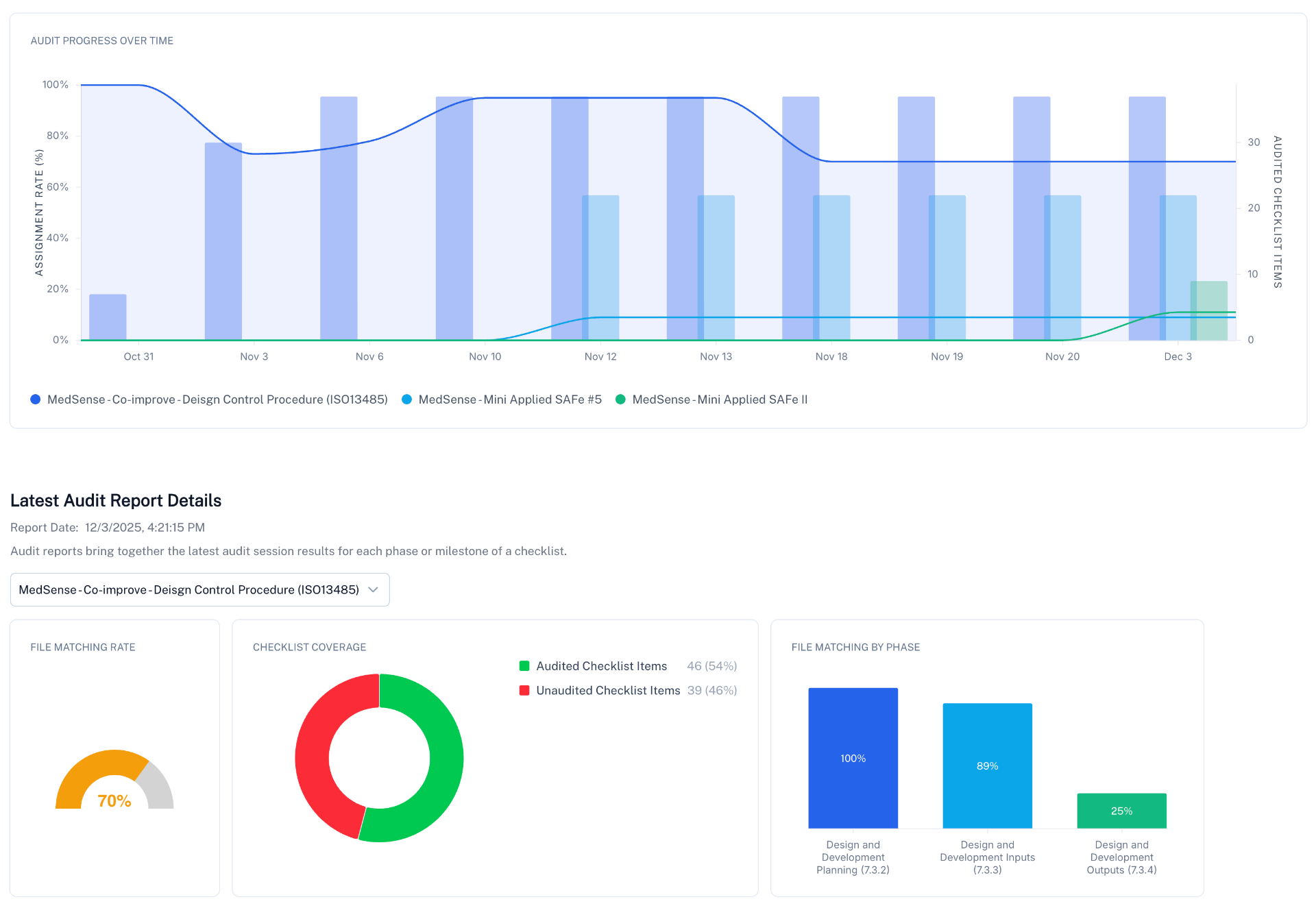
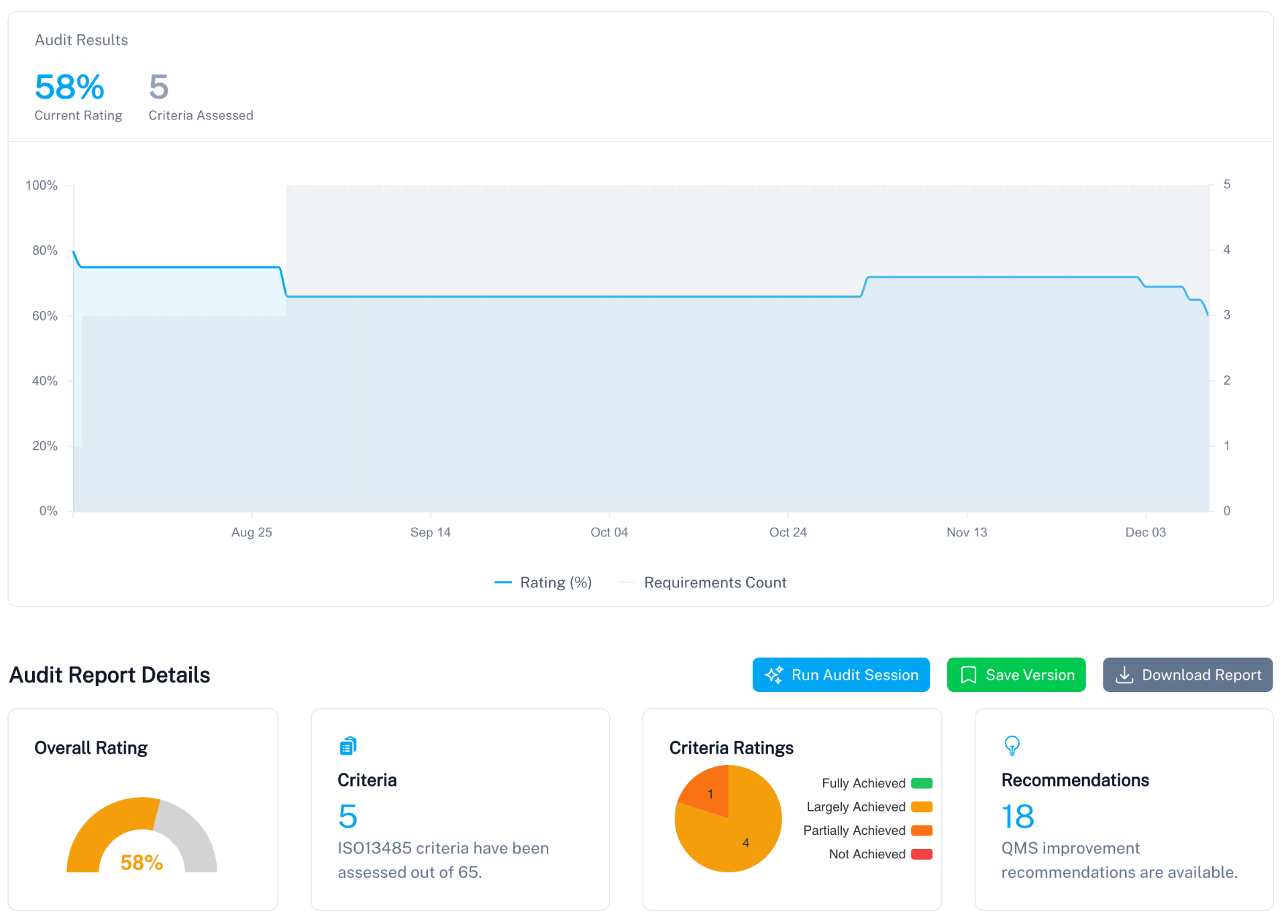
Applied SAFe processes, checked against the standard
- Applied SAFe checklists as the audited process
- Assessed against the standard's criteria
- Every rating traced to the matched evidence
- Improvement recommendations per finding
Product status
What exists today
Two of the three pieces below are in customer use. The third is in development.
Applied SAFe
The Applied SAFe implementation, maintained as a lean QMS and in use at customers today.
The PEDCO AuditPro engine
The conformance, evidence and analysis technology behind the reports above — running against real quality systems today.
The integrated platform
The loop above as one system on one object model. Design partners shape it and get it first.
Two ways to start
Design partners shape the platform and get it first. The gap check is a standalone piece of work you keep either way.
We review every application and reply within two business days.