Revolutionizing Compliance with Advanced Technology
Discover how advanced graph-based technology redefines compliance audits—powered by knowledge graphs, targeted clustering, progressive summaries, and specialized AI agents.
The innovative backbone of smarter auditing
PEDCO AuditPro ensures accuracy, efficiency, and actionable insights at every step through four core technological pillars.
Knowledge Graph
Creates a dynamic map of your QMS, connecting roles, processes, and activities for a holistic view.
Clustering and Summarization
Groups related QMS content into clusters and generates summaries for efficient query and retrieval.
Hierarchical Structure
Data is organized into a hierarchical structure facilitating understanding at various levels of abstraction.
Audit Agents
Each AI agent focuses on specific tasks, from criteria assessment to validation, for precise audit results.
How we verify
Three principles govern every check the platform runs.
Claims, not models
We check exactly what your documents state—never an ordering, structure, or process the sources didn't claim. Every finding traces back to a real sentence and clause.
Humans confirm before anything enforces
Compiled rules and expectations run in shadow mode until your experts approve them. Confirmed decisions are remembered and survive re-analysis.
Integrate, don't replace
CI gates, workflow validators, and specialist tools you already run are consumed as evidence sources. Enforcement at the source outranks after-the-fact inspection.
Knowledge Graph
Overview
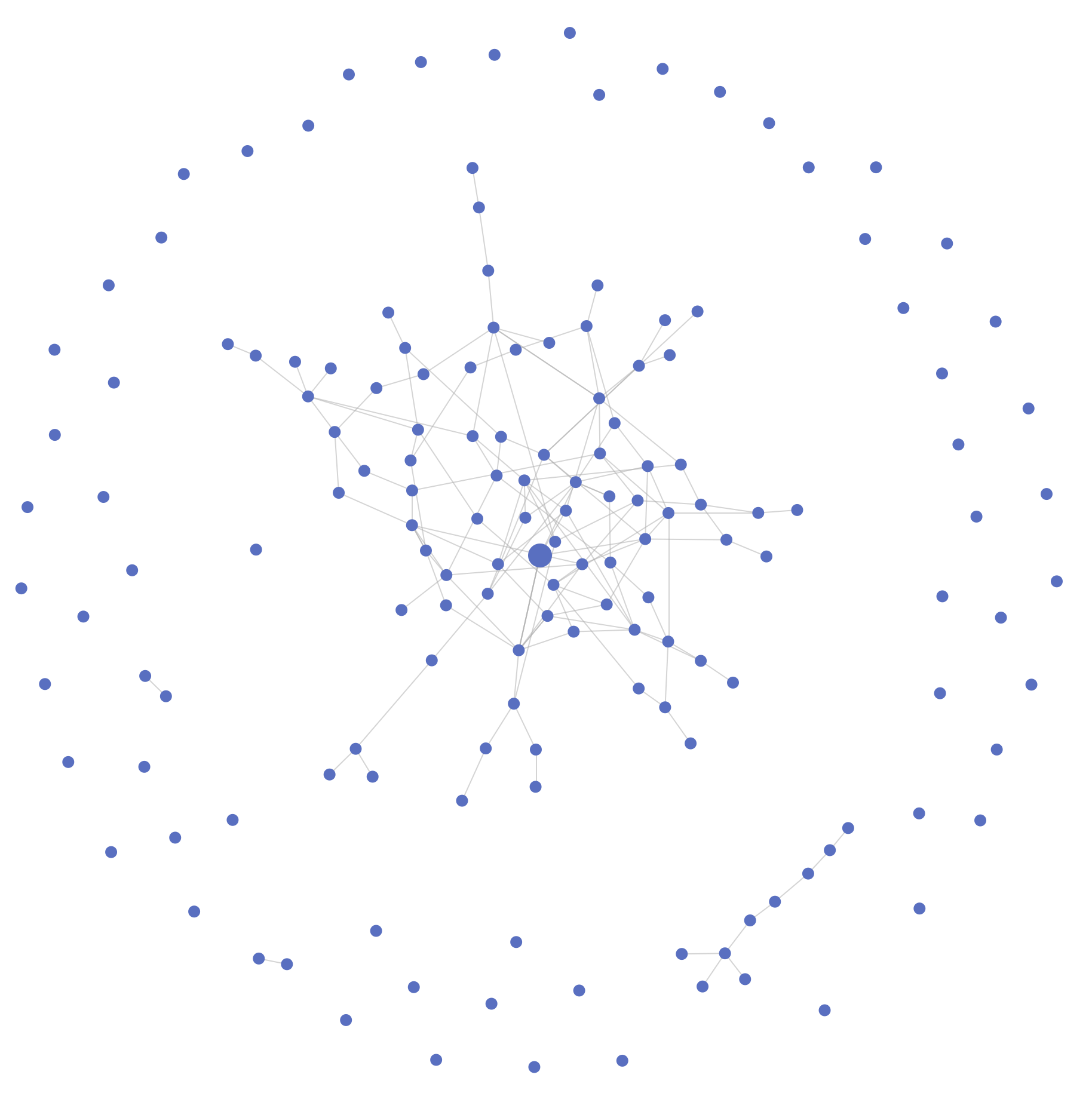
PEDCO AuditPro's knowledge graph technology creates an interconnected map of your Quality Management System (QMS). Unlike traditional linear audit approaches, knowledge graphs represent the intricate relationships between roles, processes, practices, and activities within your organization. This holistic view helps uncover dependencies, highlight gaps, and ensure a deeper understanding of your QMS.
Why it's needed
Modern QMS processes are highly complex and interconnected, often spanning multiple teams, departments, and workflows. Linear methods fail to capture the nuances of these systems, making it difficult to identify gaps or inefficiencies. A knowledge graph approach is essential to represent these complexities, providing clarity in even the most intricate systems.
Clustering and Summarization
Overview
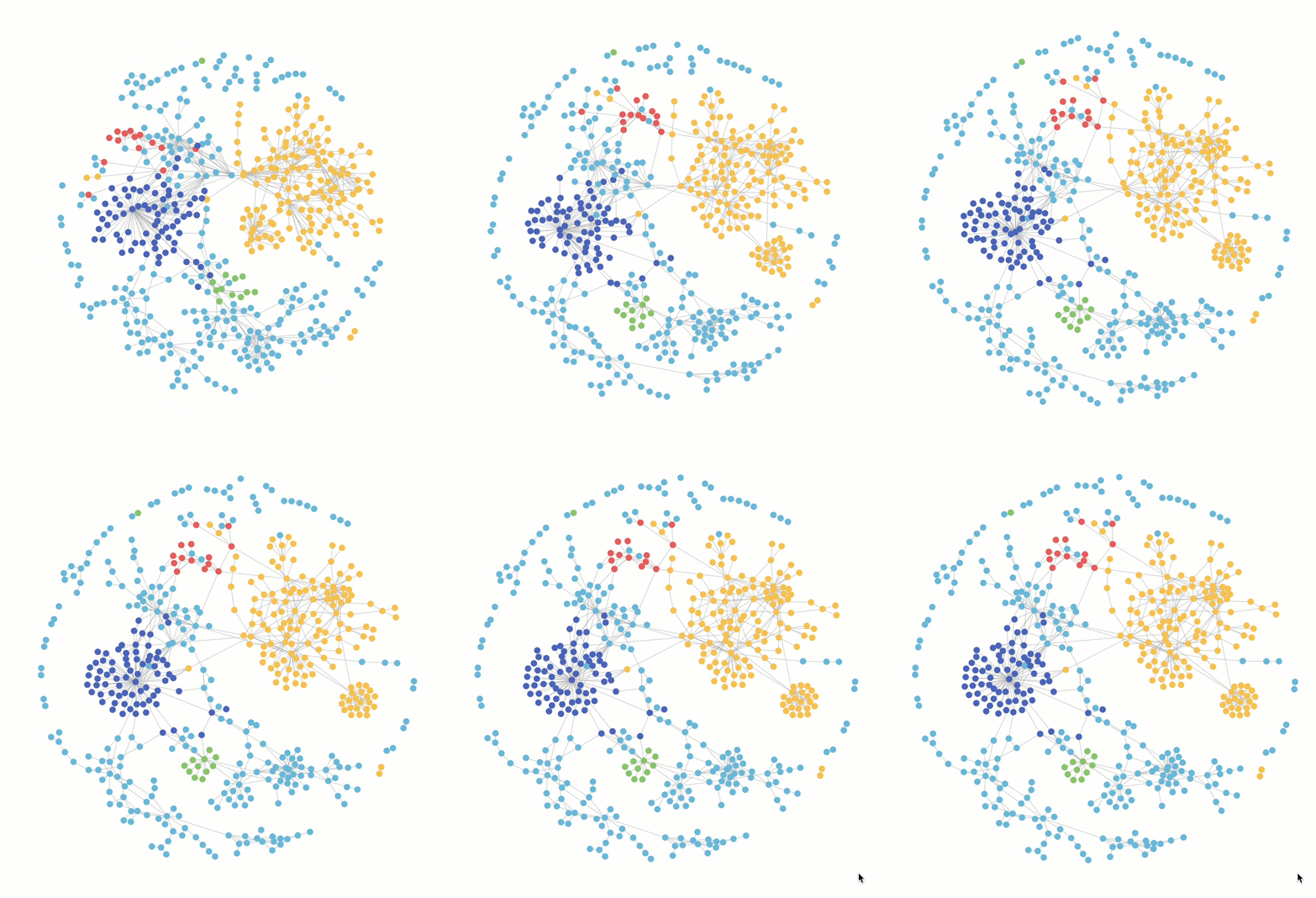
PEDCO AuditPro leverages advanced clustering techniques to identify related content within your Quality Management System (QMS). By grouping connected data, it generates high-level summaries at multiple hierarchical levels. This approach provides a holistic understanding of your QMS, allowing you to zoom out for the big picture or dive into detailed insights as needed.
Why it's needed
Managing large and complex QMS data can be overwhelming, making it hard to pinpoint priorities or understand the full system. High-level summaries help streamline decision-making by providing clear, structured insights without losing sight of the overall QMS structure.
Hierarchical Structure
Overview
PEDCO AuditPro employs hierarchical summaries to analyze each standard requirement, starting with a high-level overview and progressively drilling down into specific details, processes, and documentation. This structured approach provides both a broad perspective and granular insights, ensuring a thorough evaluation of compliance requirements.
Why it's needed
Audits often struggle to balance a strategic overview with the need for detailed evaluations. Hierarchical summaries ensure every standard is thoroughly assessed, helping decision-makers maintain focus on overarching goals while addressing specific compliance gaps.

Audit Agents
Overview
PEDCO AuditPro leverages a suite of specialized AI agents to streamline and enhance the audit process. These agents handle tasks such as criteria assessment, requirement rating, rating validation, and summarization, ensuring that every aspect of your audit is addressed with precision and efficiency.
Why it's needed
Effective audits require specialized expertise at every stage, from evaluating criteria to validating outcomes. AI agents provide this expertise consistently and at scale, reducing human error and increasing efficiency without compromising quality.
How It Works
A two-step workflow that transforms QMS content into actionable audit insights.
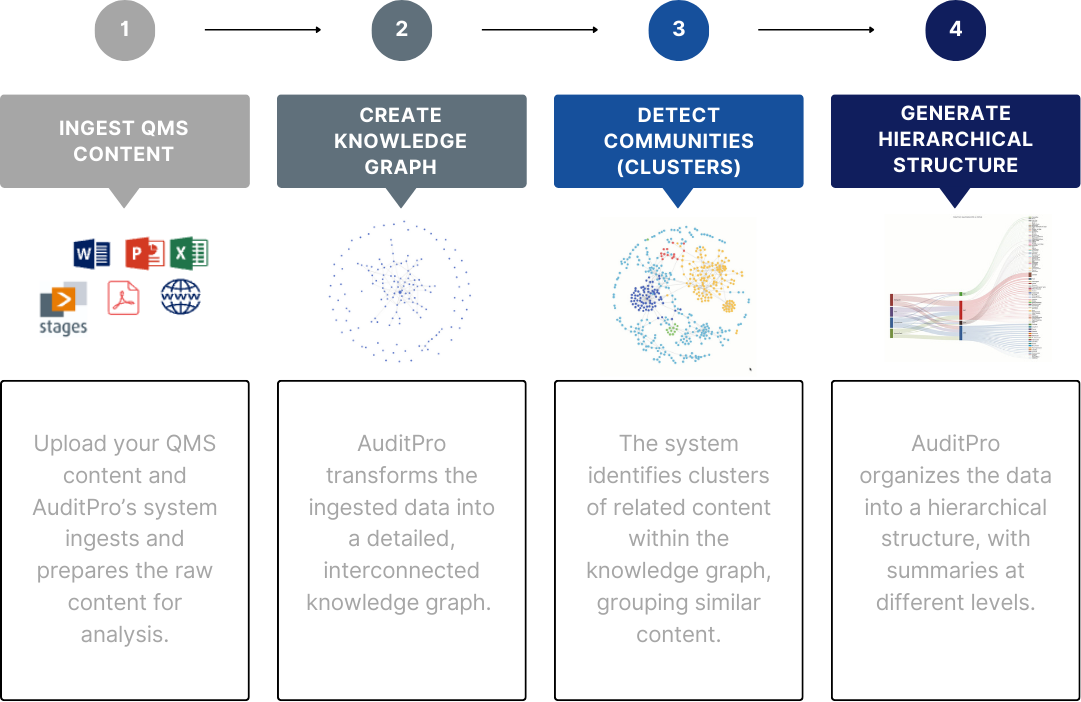
Upload your QMS content and PEDCO AuditPro transforms it into a detailed, interconnected knowledge graph. The system identifies clusters of related content and organizes everything into a hierarchical structure with summaries at different levels.
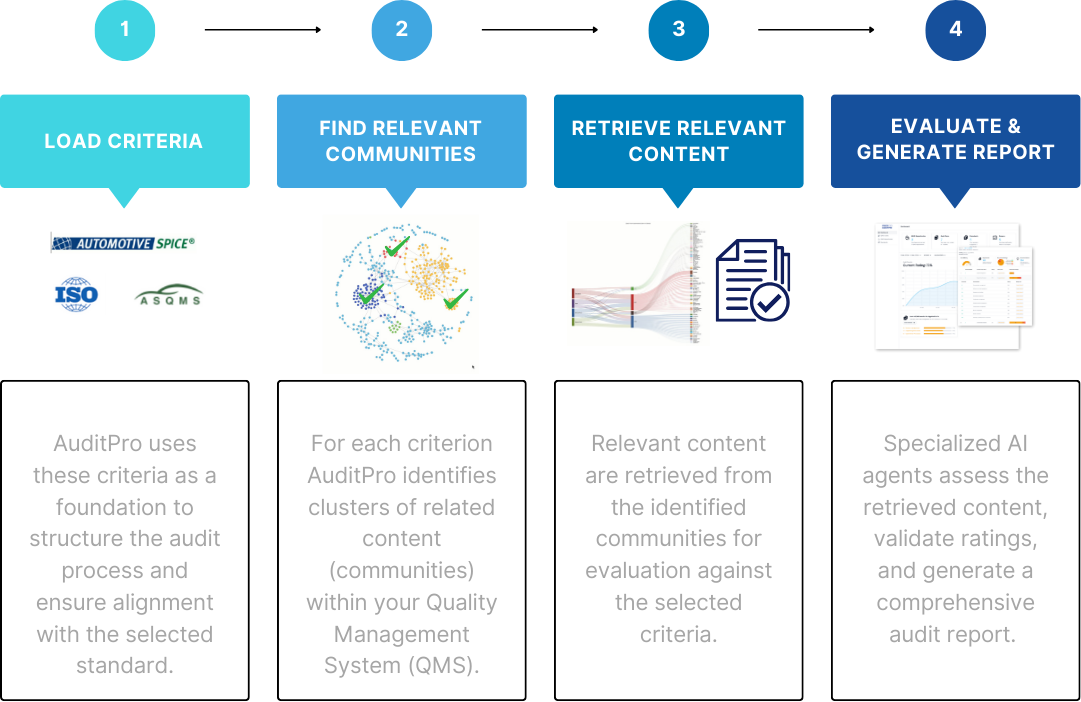
PEDCO AuditPro uses loaded criteria as a foundation to structure the audit process. For each criterion, it identifies relevant communities, retrieves content for evaluation, and specialized AI agents assess the content to generate a comprehensive audit report.